
Champaign County Busted Mugshots
A mugshot comes from the booking desk. It is taken when an arresting agency brings someone into the county jail system. The Sheriff runs the jail and the public inmate records portal in Champaign County. Several departments can make the arrest: Champaign Police, Urbana Police, Rantoul Police, and the University of Illinois Police. Most state-law arrests end up at the county jail. Federal custody works differently. The Champaign County Sheriff's Office fills the countywide law-enforcement role and links out to jail and corrections resources.
A booking entry changes as the case moves. Bond review, detention, release, and court dates all sit ahead. So know what each tool answers. A current roster answers one narrow question: is this person in custody right now? A dated booking report answers another: who entered the jail during that daily window? Keep the two straight and you will read both correctly.
That is why a photo should stay tied to its source and date. The official portal may show an image when one exists. It does not promise a picture for every row or a permanent archive after release. For direct contact, the Sheriff contacts page separates the main office from jail information, criminal records, warrants, investigations, and records requests. That breakdown helps when a name match alone is not enough. Before treating a record as the right one, compare the arresting agency, the arrest date and time, the SO or booking number, the facility, and the case number.
A booking photo, charge label, bond amount, or jail entry is just one piece of the picture. The public court case tells the rest of the story.
Not everything created at booking reaches the public screen. Illinois jail standards call for a booking record and photograph at admission. That rule does not guarantee every field or image gets posted online.
Where a record lives depends on custody. Someone just booked may show up in a daily report. Someone still held may appear on the current roster. A released person can drop off the roster while the dated booking record stays obtainable. A person sent to state prison moves into the Illinois Department of Corrections system instead. Think of the county's booking path as a chain of official records, not a single gallery. Match the source to your question, and keep the agency and date with any notes you take.
Note: The county portal is a current-custody view, so a missing name does not prove that no arrest or booking occurred.
A screenshot from the Sheriff's official site shows the county's public entry point for jail and law-enforcement information. Treat it as a source map rather than a booking-photo display.
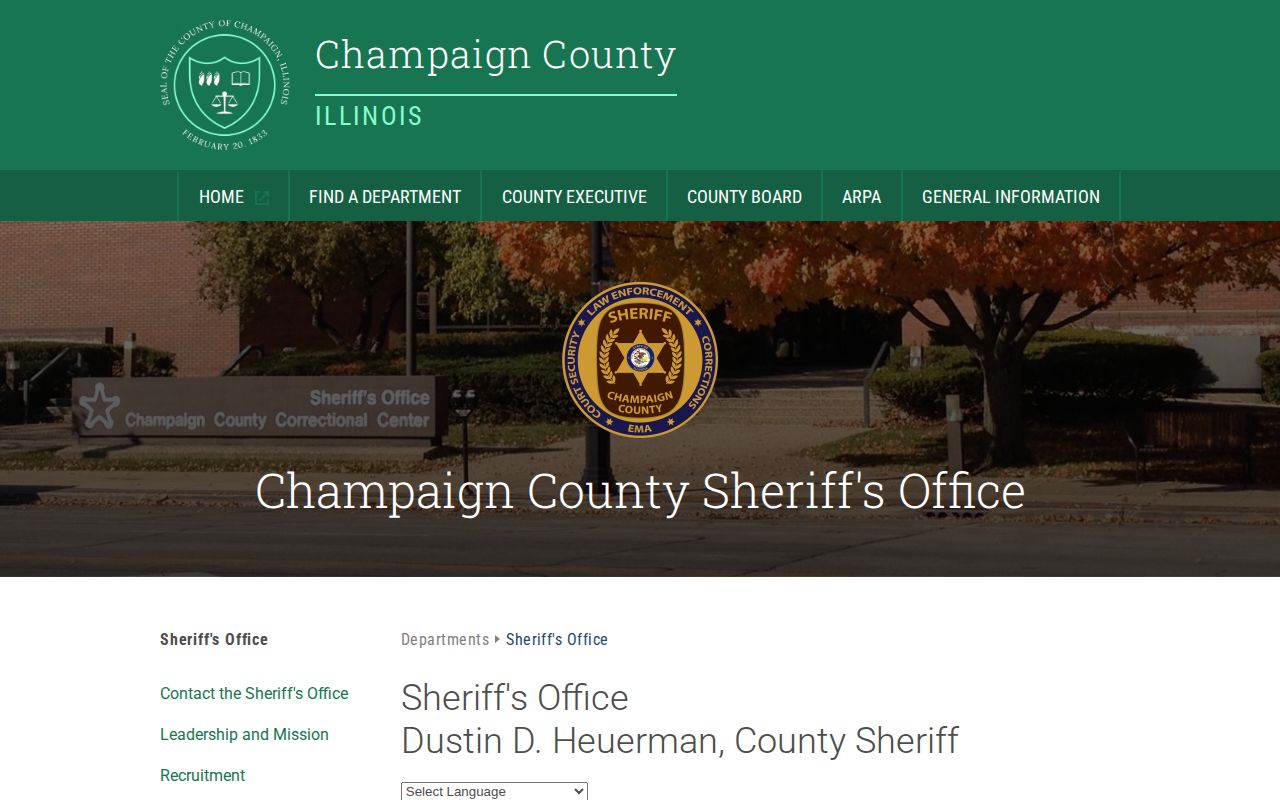
Live booking information sits behind the Sheriff's corrections links. Questions about an arrest report, a warrant, or a records request go to the named unit instead.
Fields in a Champaign County Busted Booking Record
The official current portal splits its results into Details, Charges, and Bonds. The first view can show a name or ID, an arrest date and time, an age, and the arresting agency. Opening a record reveals more. The fields below reflect what the county interface and daily report contain, not a promise that every person has every field or an image.
| Field | What it can show |
|---|---|
| Name and SO number | The identity label and Sheriff's number used to distinguish records with similar names. |
| Booking number and dates | Booking identifier, arrest time, and release time when entered in the record. |
| Agency and facility | The arresting agency and the facility or custody location attached to the entry. |
| Physical description | Race, gender, age, hair, eyes, weight, height, aliases, and other identity fields observed in the Details view. |
| Charges | Charge name, class, charge-level disposition field, case number, arrest date and time, and agency. |
| Bond | Bond count, total amount, bond type, amount tied to a charge, and related bond information. |
| Photo | An image slot that may display a booking photo, or a no-image placeholder when the public record has no visible image. |
| Daily report fields | Warrant or issuing authority, SO number, description, confined status, charges, bond amount or type, and an Image column. |
Illinois jail standards describe a much broader administrative record than the website shows. That record can hold the admission authority and time, the holding offense, officer names, attorney contact, property and medical information, visitors, temporary absences, misconduct, the judge, the court, and the disposition. These categories explain what a custodian may have on file. They are not public web fields unless the county interface or a released record shows them.
A booking number or SO number beats a name for matching one specific record. To look someone up yourself, use the current portal at Champaign County inmate records search. Save the update time, search date, and record identifier if the result matters later.
Note: A visible photo confirms what the public interface displayed at that time, not a permanent right to an image or a finding about the charge.
Roster fields and court fields are not the same thing. The roster may show a bond or a pending charge. The Circuit Clerk's public case path may later show a hearing, an amended charge, a dismissal, supervision, a plea, a sentence, or another disposition.
Requesting a Champaign County Booking Photo
When the current roster or a dated PDF will not answer a specific question, the Sheriff's written FOIA route is the next step. The Sheriff FOIA page gives the agency information, and the FOIA form asks for enough detail to locate and review a record. Ask the agency to state any lawful duplication cost or exemption. No booking-photo-specific fee or fixed photo-retention period appears in the county material.
A focused request gets reviewed faster than a demand for an entire jail database. Include the person's full name, an approximate booking date, the arresting agency, and the SO or booking number if you have it. Name the exact record you want. State plainly that you are requesting a booking photograph if it is public and available. The form notes a five-working-day response for records covered by the Act, with a possible extension under the applicable FOIA framework.
- Open the Sheriff's FOIA page and current form. Confirm the destination and current instructions before sending the request.
- Identify the person, date, arresting agency, SO or booking number, and record type. Ask for the booking record and photo if available and releasable.
- Choose inspection or copy and electronic delivery when offered. Include contact information and a signature as the form requires.
- Keep the request, response, source URL, and any redaction or exemption explanation together. Ask for segregable material if part of the record is withheld.
Champaign County Sheriff's Office
102 E. Main Street
Urbana, IL 61801
General: 217-384-1204
FOIA: 217-384-1205
Records/Warrants: 217-384-1233
Jail and bond information
Satellite jail
502 S. Lierman Avenue
Urbana, IL 61802
Jail information: 217-384-1243
Jail Supervisor: 217-819-3534
Start with the right door. The Sheriff's main office takes records requests Monday through Friday, from 8:00 AM to 4:30 PM, and it closes on holidays. Questions about bonds, visitation, or jail charges? Call the jail line instead. An urgent threat is a 911 matter. Never bring that to a records call.
City arrests follow a different path. A police report belongs to the agency that made the arrest. So Champaign Police, Urbana Police, and Rantoul Police each handle their own requests. The Circuit Clerk does not hold arrest records at all. For a county booking record or a jail-held photo, the Sheriff is the direct route.
Sealing or expungement changes what agencies can share. Give the record holder a certified court order or proof of correction. Don't assume a search result updates itself just because a court acted.
Note: A named booking request with a date and agency gives the records unit a clearer target than a request for every jail image.
Illinois Mugshot Law and Free Corrections
Illinois sets the baseline for public arrest information. Under 5 ILCS 140/2.15, covered arrest information must be public promptly. The deadline is 72 hours after the arrest at the latest. The statute spells out what that includes: name, age, address, a photograph when and if available, charges, the time and place of arrest, the arresting agency, and details on custody received, discharged, or transferred. That phrase "when and if available" matters. No law forces every public interface to post an image in every case.
The same statute protects juvenile confidentiality and other criminal-record limits. It also bars law enforcement from posting certain lower-level booking photos on social-networking sites. A listed public-safety or search exception must apply first. That rule targets social media, not county jail portals. A portal, a daily report, and a records request each play by their own access rules.
Illinois also went after pay-to-remove schemes. 815 ILCS 505/2QQQ makes it illegal to demand money or anything of value to remove, correct, or modify covered criminal-record information. Treat any paid-disappearance promise with real caution. The official fix for a wrong name, wrong charge, or wrong disposition starts with the Sheriff, the arresting agency, or the court.
When a case qualifies for a legal remedy, the Illinois Courts expungement and sealing forms and 20 ILCS 2630/5.2 govern the process. Acquittal, dismissal, release without charge, reversal, supervision, and conviction each carry different waiting periods and conditions. Locally, the Circuit Clerk's instructions and the Legal Self-Help Center can assist. Eligibility still turns on the full record and current law.
Stick to free, source-based correction paths. BustedNewspaper, RecentlyBooked, Mugshots.com, and Mugshots.zone each publish their own free correction or removal policies. Those policies can change a third-party copy. But they can't seal a court case or touch a Sheriff's record.
Third-party sites want specifics. Bring the exact URL plus court or agency paperwork. BustedNewspaper's free listing form accepts grounds like expunged, dismissed, sealed, or not-guilty outcomes. RecentlyBooked's policy covers free requests for incorrect, outdated, duplicate, juvenile, dismissed, expunged, or sealed material. Mugshots.com's contact policy and Mugshots.zone's form list their own documentation rules too. Always try the official agency and court path first.
Search engines can lag behind the source. Google's outdated-content tool, Google's removals guidance, and Bing's webmaster help tackle those lingering indexed copies. None of them alters what the Sheriff or the court actually holds.
Note: A free third-party correction request can update an unofficial index, while only the record holder or court can correct the official source.
How to Find Champaign County Busted Mugshots
Custody stage decides where to search. Begin with the county's current roster. Then work back through the dated booking window or sideways to the arresting agency. Court and state systems answer only for the stage they cover. Match the tool to the question.
- Search the current inmate portal by name or ID number. Compare arrest date, age, agency, facility, image, charges, and bonds.
- Open the Sheriff's public documents page and check the current or archived Inmate Bookings Report for the recent daily window.
- Use the In-Custody Arraignment Report when the question is who remains in custody for a bond or arraignment court appearance.
- Check the Circuit Clerk's public-access page for case events and later disposition. The Clerk directs arrest-report requests to the arresting agency.
- Use the city police report or FOIA path for incident context, and the Sheriff FOIA path for a named county booking record or photo.
Custody type matters as much as county. A person sentenced to Illinois state custody shows up in the Illinois Department of Corrections offender search, not the county roster. Federal custody runs through the Bureau of Prisons locator or an agency request. Immigration cases use ICE's locator. No single public list merges all of these systems.
Absence from a roster can mean several things. The person may have been released, transferred, sealed, corrected, or never included in the public current set. An empty IDOC result could mean the person is still in county jail, sits in another system, or has been discharged. And a missing photo doesn't mean no photo was taken.
Third-party county pages can serve as leads. Their coverage can lag, and their date labels may differ from official ones. Confirm anything you find with the Sheriff, the arresting agency, the court, or a records response before relying on it.
Note: Match the source to the custody state before treating a name, image, or charge as a current Champaign County record.
Official and Unofficial Mugshot Sources
Official sources come first here. The table also lists local secondary pages. Those surface in search results anyway. A third-party page isn't run by Champaign County, and it may be incomplete or stale. It proves nothing about current custody or a final disposition.
| Channel | Photo or record | Status and use |
|---|---|---|
| County current inmate portal | Photo when present, plus details, charges, and bonds. | Official current-custody source. Search by name or ID. |
| Inmate Bookings Report | Daily booking fields and an Image column. | Official preceding-24-hour window. Check dated archives. |
| Arraignment and Daily Reports | Court-stage and release or population context. | Official reports, not a complete photo search. |
| Records request | Specific booking record or photo if public and available. | Official fallback through the Sheriff or arresting agency. |
| State DOC search | No public photo was observed in the search interface. | Official state-sentenced custody only. |
| Local news | Story-specific images may be supplied by an agency. | Narrative coverage, not a complete booking feed. |
| BustedNewspaper Champaign County | Unofficial local booking index with names, dates, and images. | Secondary and potentially delayed. Verify with county sources. |
| RecentlyBooked Champaign | Unofficial recent-arrest section. | Coverage can be empty or stale even when county sources have records. |
| Mugshots.com Champaign County | Unofficial historical index with city links. | Older dates are not current custody evidence. |
| Arrests.org Champaign County | Unofficial grid with photos and charge snippets. | Coverage is incomplete and not a government record. |
| Mugshots.zone Champaign | Unofficial local index with images and charge fields. | Date ranges are uneven. Treat as a lead only. |
Photos belong on the source page. The county portal and the local news pages are linked for context, never copied into a gallery here.
Statewide and federal questions call for different tools. The BOP locator, the ICE locator, and the IDOC search each cover one custody system. A county booking should never be relabeled as a state or federal record.
Champaign County Busted Records in Current Custody
The county's current inmate records portal opens with a heading that reads "All current inmates." Visitors get a search box for name or ID, a result count, a load-more button, and a last-updated stamp at the top. Each card carries the basics: name, ID, age, arrest date and time, and the arresting agency. Photos appear on some cards. Open one, and the record splits into tabs for Details, Charges, and Bonds.
| Search or record field | Observed purpose |
|---|---|
| Name or ID number | Primary search prompt. An ID or SO number helps separate similar names. |
| Arrest date and time | Places the entry in the custody timeline. |
| Arresting agency | Shows whether the arrest began with a city police agency, University Police, Sheriff, or another agency. |
| Details tab | Physical descriptors, aliases, booking number, facility, holds, and release time when entered. |
| Charges tab | Charge name, class, disposition field, case number, agency, and arrest date or time. |
| Bonds tab | Bond count, total, type, amount, and associated charges. |
A short routine works best. Search by full name or ID, then match the arresting agency and arrest date. Open the detail tabs. Note the portal's update time before you leave.
- Search by name or ID number and review more than the first visible card when the portal offers a load-more control.
- Compare arresting agency, age, SO number, arrest time, and facility before opening a record.
- Read Details, Charges, and Bonds separately. A charge is an charge; a bond is a custody decision.
- If the person is missing, check the daily booking report, archived reports, arresting agency, court file, or a focused FOIA request.
Some live records show a photo. Others show a placeholder. No universal photo rule is published, and the public page says nothing about how long images stay up after release. For general arrest information, the Sheriff points people to the daily Corrections Division reports. A person can appear in the booking PDF, then vanish from the current roster after release or transfer.
There is also an official app. The Google Play listing and the Apple App Store listing mention inmate information, tips, community collaboration, and critical updates. Neither promises a separate photo feed or faster updates. The web portal stays the confirmed route for booking photos.
For custody alerts rather than images, VINE is the stronger tool. Illinois VINE links participating jail and court systems. It sends status notifications online or by phone. It is not a gallery of any kind. The Sheriff's official Facebook and X account are news channels, not complete booking feeds.
Note: Record the portal's update time and the search date whenever a current-custody result must be checked again later.
The Sheriff's public documents page gathers the current and archived corrections reports in one spot. Think of it as the route to dated files rather than a standing photo archive.
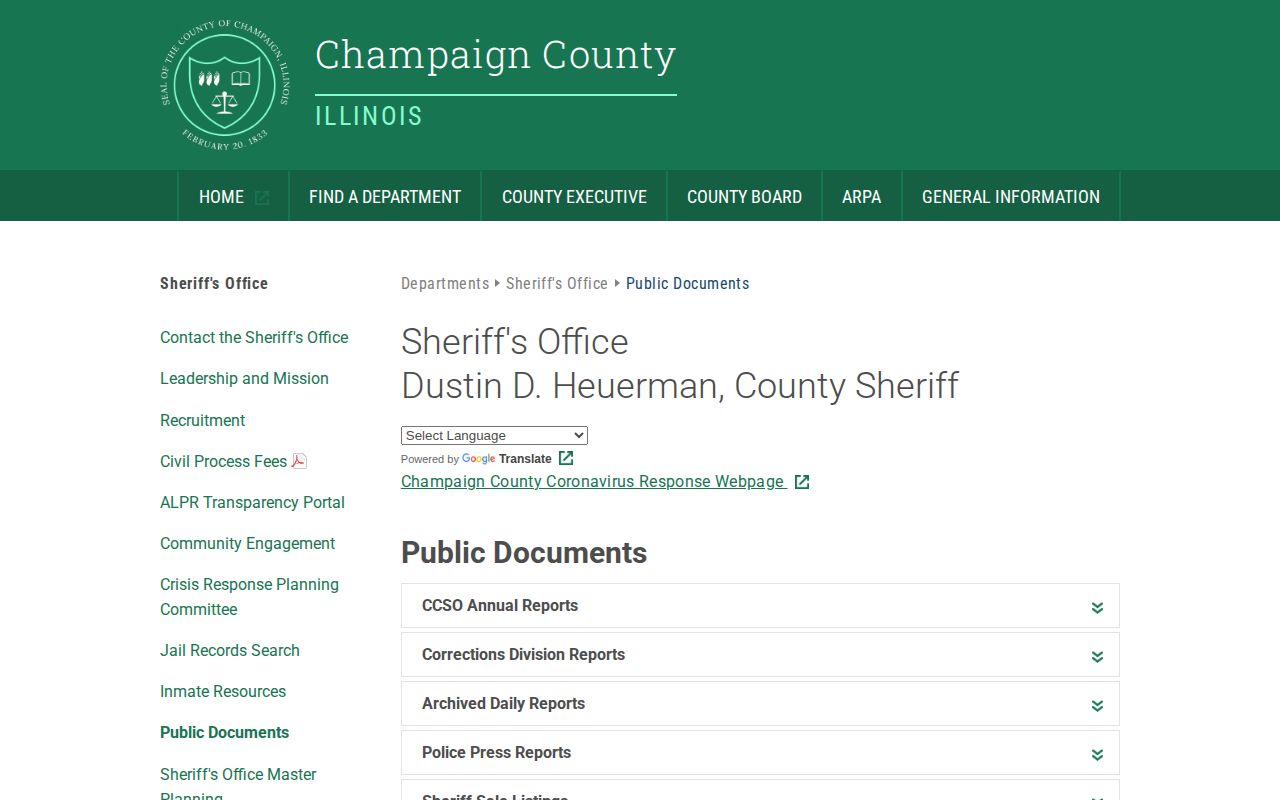
The daily report links earn their keep when the live roster has already changed, or when you need a booking from an older date.
Champaign County Bookings from the Daily Window
The Inmate Bookings Report is the county's clearest same-day booking source. The 2025 annual report describes it plainly. It lists people brought to the jail in the preceding 24 hours, refreshed daily, with warrant versus original-charge information. Entries include SO number, name, description, confined status, arresting agency, charges, bond amount or type, and an Image field. County-jail and Out of Facility sections split the list.
That daily window is not the current population. A person can enter the PDF and later leave the roster, transfer, or shift to Out of Facility. The broader Daily Report adds arrests, bookings, releases, release types, and population counts. Two companions help too. The In-Custody Arraignment Report covers people in custody appearing in arraignment or bond court that day. The Jail Census Report captures the population at a point in time.
Champaign County has no separate 72-hour or weekly mugshot page. For a multi-day check, open the public documents page and pull each dated report listed there. The dated sequence runs forward into January 2026. No fixed archive start or retention promise is stated.
A current report suits a fresh booking. An archived PDF is the fallback once the roster drops a released person. If the Image entry is missing, make a named request instead of trusting an unofficial copy. Weekends bring no separate feed either. The report follows its own published cycle, and exact posting minutes are not stated. Check the portal first, then the dated report, and compare agency and date.
Note: “New booking,” “current custody,” and “in-custody court appearance” are three different labels in the county report family.
The Sheriff's inmate-lookup instructions give the official word on where to look. They point to the current portal and the daily Corrections Division reports, matching the order described above.
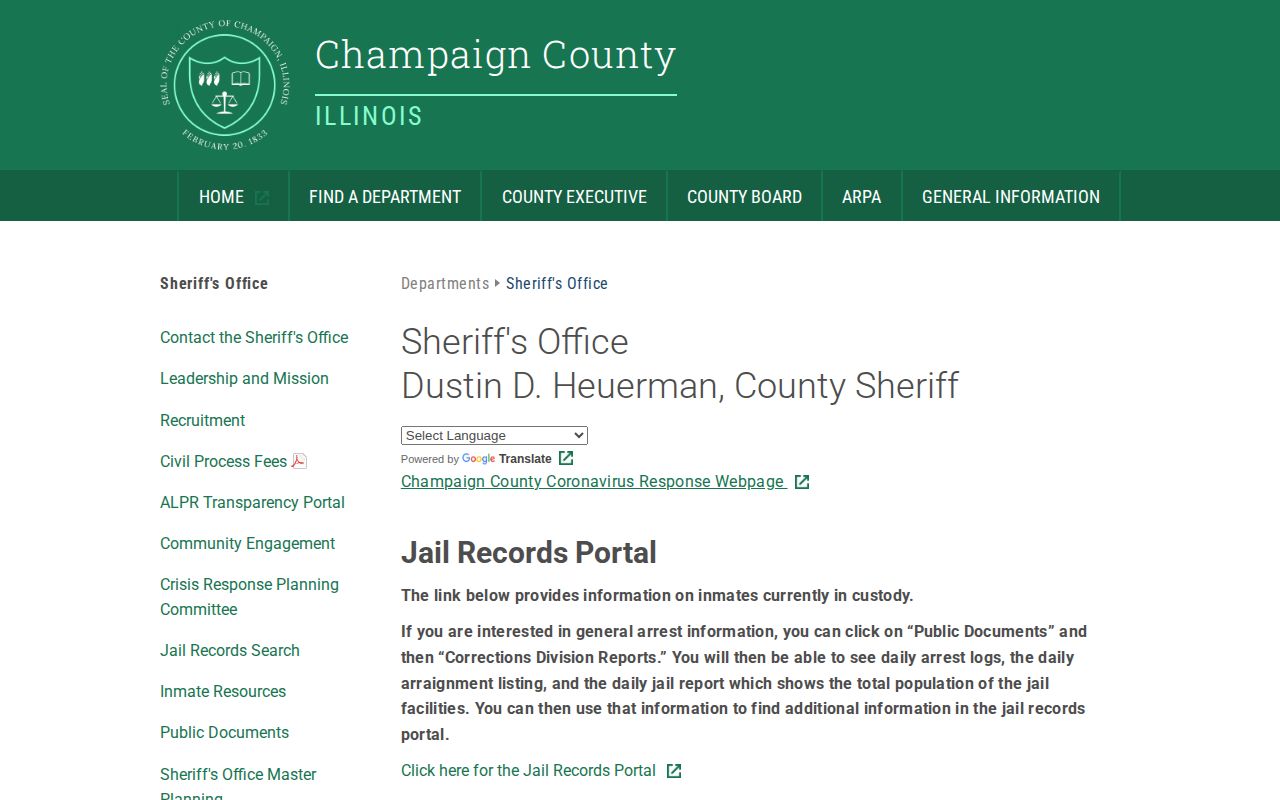
When a booking seems to have moved between systems, pair the report's date with the portal's update time. The two together usually settle it.
When a Busted Record Reaches IDOC
The Illinois Department of Corrections search covers people sentenced to state custody in Illinois. It will not replace the Champaign County booking portal. That portal still matters for someone just arrested, still held locally, or awaiting a county court outcome. The search takes a last name, an IDOC number, or a birthdate in MM-DD-YYYY format. An IDOC number pins down the right result fastest.
Treat the state search as a status and identity locator. No public photo appears in its interface. IDOC's own materials note why a result may be missing. Someone may sit in a county jail awaiting trial or sentencing, be held in another prison system, or have been discharged. A missing result does not erase the county booking that came before.
| Custody question | Use this source |
|---|---|
| Recent local booking | County Inmate Bookings Report and current inmate portal. |
| Current county custody | Champaign County current portal, with a photo when present. |
| State-sentenced custody | IDOC search and, for a specific public record, the IDOC FOIA route. |
| Federal custody | BOP locator or agency request. The public locator did not show booking photos. |
State prison records follow different rules than county jail records. IDOC's FOIA process treats photographs as public records that may carry exemptions. The response window is five working days, with room for an extension. The fee schedule helps too. The first 50 black-and-white pages cost nothing, and each page after that runs $0.15, with separate pricing for other media. Any request for a prison photo should include the person's full name, the IDOC number if you have it, a date, and a precise description of the record you want.
For a county booking photo, go back to the Sheriff or the arresting agency. The IDOC search screen exists for one purpose: finding people in state custody. Its identity fields are built for that job. It is not a county mugshot gallery. A move from local booking to state prison does not convert one record into the other or promise the same photo appears in both places.
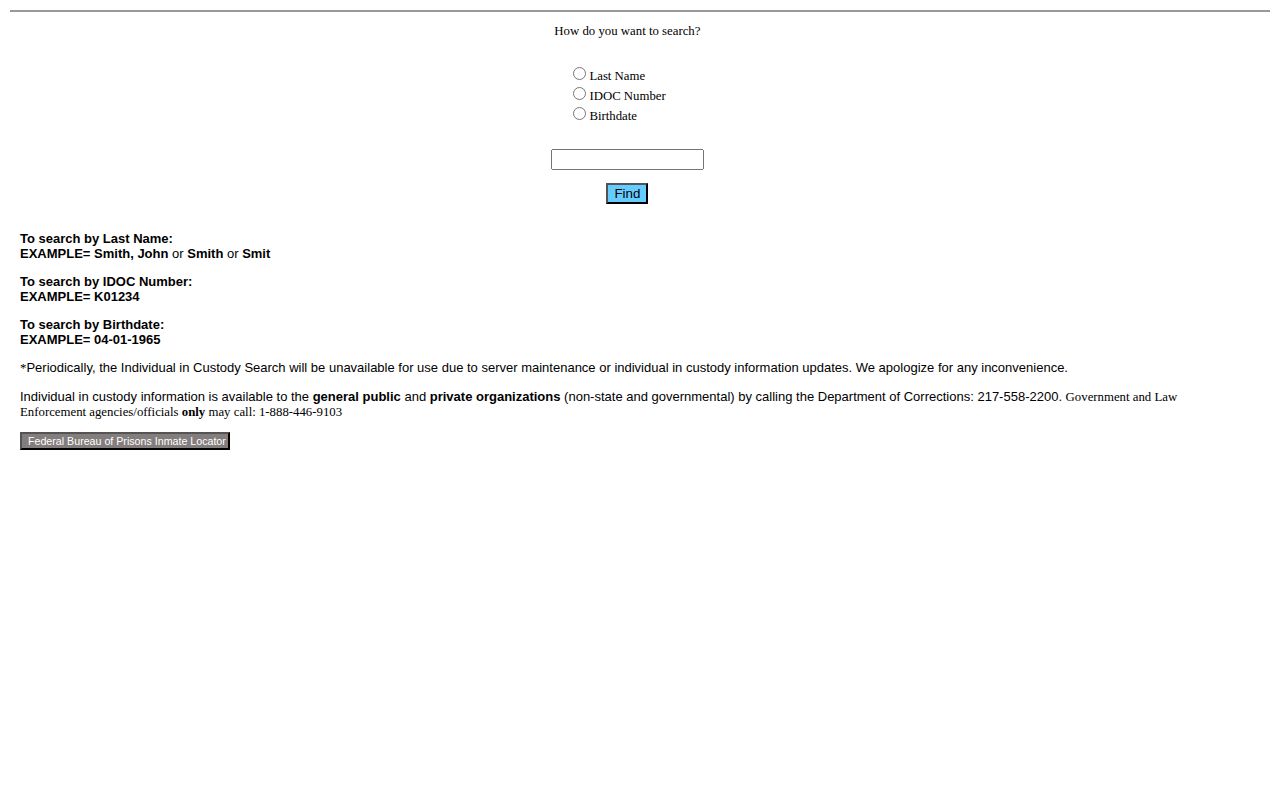
Use the state locator only when the question is an Illinois prison sentence.
Booked, Released, or Sentenced
One source can drop a record while others keep it. The custody map below keeps five paths distinct: the county booking record, the court file, state prison, the federal locator, and the immigration locator.
| Custody stage | Best source | What the source does not prove |
|---|---|---|
| Just booked or recent | Inmate Bookings Report, generally the preceding 24-hour window. | It does not prove current custody or guilt. |
| Current county custody | Current inmate portal, with a photo when the record includes one. | It is not a complete arrest archive or final disposition. |
| In custody for court | In-Custody Arraignment Report and Circuit Clerk case search. | A hearing listing is not a conviction, dismissal, or acquittal. |
| Released or transferred | Dated county reports, arresting agency, FOIA, and court file. | Leaving the roster does not resolve the charge. |
| State-sentenced | IDOC offender search and IDOC records request. | The state locator is not a county booking-photo source. |
| Federal or immigration custody | BOP, ICE, USMS policy, or a proper agency request. | There is no general public federal booking-photo gallery. |
Illinois VINE sends custody and court alerts through participating systems, which helps when a status change matters. Alerts are not records, though. They replace neither the image, the court file, nor a formal records response. The federal side is quieter. The public BOP locator shows no booking photos. ICE's locator posts no public photo. U.S. Marshals guidance says there is no general public disclosure of federal prisoner histories or photographs.
Older jail records need a different route. The current portal only goes so far. The Sheriff FOIA path suits a recent record. For aged jail registers, try the Illinois State Archives local holdings search and the IRAD Sheriff collections. A historical register might list names, physical descriptions, and commitment and release details. No public Champaign County photo collection turned up, however. Labeling the source in a note prevents mixups, like calling a released booking "current" or reading an ICE result as a county jail record.
After a Busted Champaign County Booking
Booking opens the court process. It does not close anything. Under the Champaign County Public Defender's information, booking steps lead to either a notice to appear or an arraignment the next business day. Then a judge decides detention or release under Illinois pretrial rules. The Sheriff's daily In-Custody Arraignment Report links custody to that courtroom stage.
The Circuit Clerk's public-access page and its case search can reveal a case number, hearing dates, public filings, and the eventual disposition. Some matters stay limited or absent. Juvenile, sealed, and expunged categories fall in that group. Arrest reports come from the arresting police agency, the Clerk notes, not the Clerk's office.
- Booking
- Jail intake after an arrest, including identity checks and the booking record.
- Arraignment
- An early court appearance when charges and release or detention issues are addressed.
- Bond
- A release or detention condition. A bond amount is not a finding of guilt.
- Disposition
- The later court outcome, such as dismissal, plea, acquittal, supervision, conviction, or another result.
- Expungement or sealing
- Legal remedies that can limit or remove access to eligible records under Illinois law and a court order.
Read the whole case. A news item, an arrest row, a booking photo, and an arraignment entry all describe an early stage, and the court record shows the later disposition when public.
Fees differ by office. The Clerk's criminal record-search page lists $10 per year searched, plus $5 for certification. Copies cost $2 for the first page, then $0.50 for pages 2 through 19 and $0.25 after 20, with all fees paid in advance. Want a booking record or photo? The Sheriff FOIA form is the direct route. Match each request to the right custodian, and don't treat county offices as one database.
Note: A roster result can change before the first court date, so a current custody statement should always include the source date.
How Long Until a Busted Mugshot Appears?
No county source pins down the exact minute between arrest and an online image. The Sheriff annual report runs its Inmate Bookings Report on a preceding-24-hour daily window. The live portal relies on its own update timestamp. Intake, transfer, release, report production, and publication can each pull those timelines apart.
Try a practical timing check. Search the current portal first. Then open the next dated Inmate Bookings Report and compare the SO number, arresting agency, and arrest date. Once someone has left custody, the report archive or a targeted FOIA request usually beats the live roster.
A blank image has several possible meanings. It could be a placeholder, a restricted photo, or a source that has not refreshed. Maybe no public image exists at all. That does not mean no photograph was taken. The state statute says images appear "when and if available," and county materials never promise one for every row. Tie each check to the custody stage. A just-booked person may sit in the daily window. A current inmate shows in the portal. A released person appears only in a dated report or agency record. One search at one time cannot answer every mugshot question.
Champaign County Busted Records: Bond and Release Timing
Timing explains much of the confusion here. Someone can be booked in the morning and released the same day. The daily report then shows a release while the current roster shows nothing. That mismatch is normal. The Sheriff's inmate-resources page covers jail and bond basics, and the jail line takes bond questions at any hour. Under the Public Defender's SAFE-T and Pretrial Fairness material, a judge makes the detention call. A person can even walk out with no cash bond posted at all.
Keep the two documents straight. The daily report lists releases and their types. The current roster only shows who is in custody right now. So a booking record stands on its own after the name drops off the list. For payment mechanics, use the Sheriff's page and the jail line. To settle a release question, compare the portal, the dated daily report, and the court case. A third-party label is never the last word on whether someone is still in county custody.
Booking Counts Are Not Photo Counts
The Sheriff's 2025 annual report lists 3,910 inmate bookings and 3,449 arrests by law enforcement. It also counts 461 sentenced intakes and 8,910 charges. Wait, that last figure is 8,980 charges. The 2024 measures run similar: 4,193 jail intakes, an average daily population of 235, and 590 custodial arrests. Those are operations numbers across a full reporting period. They say nothing about photos. A booking count can include people released, transferred, or sentenced long ago. It cannot tell you how many public images exist, how many records sit in the current portal, or how many daily report rows carry a visible photo. The current roster, by contrast, is only a snapshot of the moment.
Treat the annual figures as scale, not as a lookup tool. Finding one person still takes the current roster, the dated booking report, the arresting agency, or a focused record request.
Champaign County Busted Records and Court Handoff
Booking and court records connect at arraignment and bond. The In-Custody Arraignment Report flags people in custody with court dates that day. From there the Circuit Clerk carries the public case history forward when the record is available. Neither source replaces the other. A roster entry might give a name and charge, while the court file later shows an amended charge, a dismissal, supervision, a plea, or a sentence. The Clerk also lists protected matters that stay out of public search.
Know where each request goes. Need the arrest report? Ask the arresting agency. Need a booking record or image? Ask the Sheriff or the custodian that created it. Keeping the court disposition, police report, and jail record in their own lanes saves everyone time. And an empty portal result does not mean no arrest happened.
Protected and Withheld Champaign Records
Public arrest data has real limits in this county. The Circuit Clerk lists juvenile, sealed, expunged, juvenile-victim, sexual-assault, eavesdropping, and impounded records among material with special access rules. Illinois arrest-information law guards juvenile confidentiality too. So a blank or thin Sheriff's portal entry can have a lawful cause.
Describe what you actually see. A missing name, charge, or image is "not found in the checked public source," nothing more. When the question needs a definitive answer, turn to the arresting agency, the court, the FOIA unit, or a legal remedy path.
Old third-party pages deserve extra care. An unofficial index can keep a stale label after the official source changed, or pin a photo on the wrong person. Compare identifiers and use the source agency's correction process. Illinois' mistaken-identity correction rule in 50 ILCS 205/4 offers another official route to review with the record holder.
Urbana Arrest Data Has No Photos
The official City of Urbana Police Arrests Data set makes a handy local supplement. It tracks arrest code, incident number, date, year, month, arrest type, crime code and description, and category, running through 2023. One catch: it is historical city data, not a live custody list. It carries no mugshots at all.
That gap explains how city and county sources can both be right. Urbana rows can stay online after a county roster entry vanishes. Meanwhile, the county portal may show a booking image the city dataset never had. Use the city set for incident context. Use the Sheriff portal or the dated booking report for current county custody. Urbana Police records and the Circuit Clerk cover the report and later court stages. Still, the county jail remains the practical cross-city booking path for state-law arrests entering county custody.
City Routes for Champaign County Busted Mugshots
The county's three city pages work the same way. Each follows the city police record first, then routes any county booking over to the Sheriff. The city channels describe incident reports and request procedures. They do not replace the county current roster or the daily booking report.
- Champaign Busted Mugshots: Champaign Police media reports are posted on weekdays for up to 30 days, and city arrests that enter county custody can be checked in the Sheriff portal.
- Urbana Busted Mugshots: Urbana Police media reports and the historical arrest dataset add city context, while the county portal is the current booking route.
- Rantoul Busted Mugshots: Rantoul Police provides Records and FOIA information, but no public daily city booking blotter was found in the reviewed material.
News outlets cover all three cities selectively, so coverage gaps are common. Watch the county label on unofficial indexes too. It can sweep in Mahomet, Savoy, Tolono, the University of Illinois, and other agencies. Always check a city name alongside the arresting agency. For an official photo, start on the custody path rather than with city size. The jail record belongs to the agency or facility that created it, even when the arrest began on a city street.