
Where Champaign County Crime News Appears
Start with the News-Gazette courts, police and fire section. It covers Champaign, Urbana, Rantoul, and the smaller towns nearby. Stories publish as events unfold, not on any booking schedule. WAND-TV, WCIA 3, and WILL from Illinois Public Media round out the picture with arrests, investigations, court proceedings, and agency statements.
Police channels sit closer to the source. Champaign Police posts weekday media reports and keeps a live SharePoint report folder. Urbana Police publishes its own media reports. Missing items there go through a request process. Rantoul Police offers records and FOIA details, though no public daily city booking-photo log exists. University of Illinois Police runs a short arrest-report window plus a longer daily crime log for campus incidents. The Sheriff's official Facebook page and X account share agency news. Neither is a booking feed.
Each source answers a different question. A news story gives context. A police media report may hand you an incident number. The county roster and booking PDF settle custody questions, and the court file takes over after that. One photo in a story is agency-supplied, never a full booking set.
A News-Gazette courts, police, and fire section view shows the local landing page itself. It is narrative journalism, not a county-run roster.
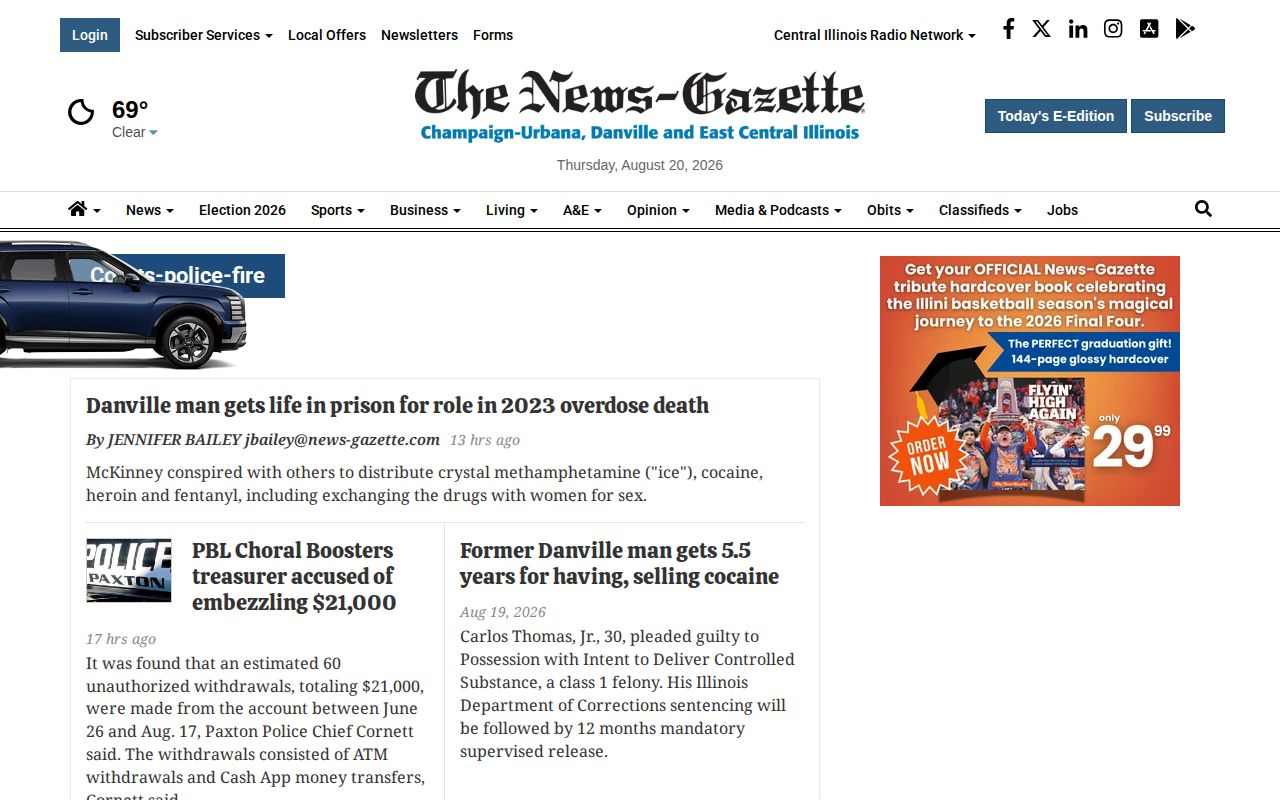
Before jumping from a story to an official record, check three things: the date, the agency attribution, and the case language. Those details decide which channel to use next.
Champaign County Outlets and Photo Sources
The table separates local journalism, agency channels, and unofficial indexes into distinct lanes. A "Photos?" entry means an image may appear in a story or page, not that the source maintains a complete photo feed.
| Outlet or channel | Coverage and cadence | Photos? | Where to check |
|---|---|---|---|
| News-Gazette | Local courts, police, fire, and narrative case coverage as reported. | Case-specific image may appear. Routine booking gallery ended in 2020. | Local section |
| WAND-TV | Regional crime stories covering Champaign, Urbana, Rantoul, and county agencies. | May use an agency-supplied image in an individual story. | Crime section |
| WCIA 3 | Regional local-news coverage as events develop. | No routine county gallery was verified. | Local news |
| Illinois Public Media / WILL | Public-media reporting about local law enforcement and courts. | Individual agency-supplied images may appear. | News |
| Champaign County Sheriff | Public documents, reports, official site updates, and social communications. | Current portal may show a photo; social cadence is not a complete feed. | Public documents |
| University of Illinois Police | Arrest reports for the last 10 days and a daily crime log for the last 60 days. | Report context, not a county booking-photo feed. | Daily log and blotter |
| BustedNewspaper | Unofficial county-local booking index with dates and agency fields. | Images may appear. Coverage can trail official sources. | County section |
| RecentlyBooked | Unofficial local recent-arrest section with uneven availability. | Images may appear. A blank page does not prove no booking. | Champaign section |
| Mugshots.com | Unofficial historical index with city links and older date ranges. | Images may appear. Old material is not current custody. | County section |
| Arrests.org | Unofficial county grid with selected charges and locality labels. | Images may appear. No complete free local correction route was verified. | County section |
| Mugshots.zone | Unofficial local index with uneven dates and agency fields. | Images may appear. Freshness is not guaranteed. | Champaign section |
The five aggregator sections appear here because they can surface in a local search, not because they carry official weight. Confirm any name, date, agency, or photo with the Sheriff, the arresting department, the court, or a records response.
The Champaign County Gallery Change
In 2020, the News-Gazette stopped its routine Champaign County Sheriff booking-photo gallery. Crime coverage continued. The local report about that change is historical policy context, not a live arrest source.
That shift explains why a search today turns up mixed results. You might find a news story, an agency report, an unofficial index, or the county portal itself. A paper can keep reporting a case without posting a wall of booking photos. WAND, WCIA, and WILL can run one agency image with a story. None promise a full local inventory.
Treat the publication change as a prompt to follow the record chain. The story's wording may describe a charge. The county or court record holds the identifier that shows what came next.
Note: An editorial image proves neither that the photo is current nor how the case resolved.
Note: A local outlet's decision to stop a routine gallery does not change the Sheriff's public-record duties or the court's case record.
How Booking Photos Reach Local News
How does a photo reach a local story? Routes vary. An agency might hand it off, a newsroom might file a records request, or it may come from a public interface or another source the outlet names. A WAND example credited an image to the Champaign County Sheriff's Office in a single Urbana arrest story. That is story-specific sourcing, not ownership of a county photo archive.
Illinois law lists a photograph, when and if available, as part of public arrest information. It also limits certain law-enforcement social-network publication of lower-level booking photos. So the county portal, the daily reports, and a records request can behave differently from a newsroom's story page.
Read the caption and the agency attribution whenever an outlet runs a photo. For a missing or disputed image, the records holder is the right first contact. A newsroom can correct its own story. It cannot touch the Sheriff's or court's underlying record.
From a Story to the Official Record
A story works as a starting point. It usually carries the person's name, the arresting agency, the date, the location, and the charge. Take those details to the official channel that matches the custody stage. The county-wide booking and record search covers the Sheriff portal, daily reports, the court handoff, and state or federal alternatives.
- Write down the story date, person's full name, agency, alleged charge, and any case, incident, or SO number.
- Check the county current inmate portal if the question is present custody. Compare the arrest date, agency, and image status.
- Check the dated Inmate Bookings Report and public-documents archive if the person was booked recently or has already left the current roster.
- Use the arresting police agency for its incident report and the Circuit Clerk for a public case, hearing history, and later disposition.
- If the record is not online, send a focused request to the agency that created or holds the record. Ask for an explanation of any exemption or redaction.
An arraignment entry marks a hearing stage, nothing more. A charge in a story or booking row can be amended, reduced, dismissed, or resolved another way. Follow the outcome. Do not repeat an early charge as final fact.
City coverage changes the path too. Champaign, Urbana, Rantoul, and University Police each publish different report windows and fields. State-law arrestees generally land in the county jail. The arresting agency and the jail custodian may not update on the same clock.
Skip the headline and check the court file. A news story marks the start of a case. It rarely shows the ending. For the outcome, the public court record is where to look. Just confirm the case is open for viewing first.
Note: Keep the story URL and the official record URL separate so a news account is not mistaken for the originating agency.
Crime News Across Champaign County
Champaign County gets steady crime coverage from the News-Gazette, WAND, WCIA, and WILL. Reporters track Champaign, Urbana, Rantoul, campus incidents, and outlying agencies. Their pages center on stories, though. They are not a daily booking window. A county arrest might surface in print after an agency statement or a court hearing. Plenty of people on the booking report never become a story at all. For city-level digging, the Champaign and Urbana pages lay out police routes, while Rantoul leans on its Records and FOIA process.
Each city handles things differently. Champaign Police keep weekday media reports up for about 30 days. Urbana Police post media reports and offer a records-request path. Rantoul Police give Records and FOIA details but no public city mugshot log. The University of Illinois Police run their own windows: a 10-day arrest report and a 60-day crime log.
The gaps matter when an arrest happens in one city but the booking lands at the county jail in Urbana. A city report can point to the agency holding the file. The county portal answers today's custody question. Older city data, like Urbana's historical arrest set, may still sit online with no photo and no current-custody field.
One more caution applies. An unofficial index wearing a county label can sweep in Mahomet, Savoy, Tolono, and other agencies beyond the three city pages. Always read the arresting-agency field before pinning a story or photo to Champaign, Urbana, or Rantoul.
Unofficial Mugshot Sections Need Verification
BustedNewspaper, RecentlyBooked, Mugshots.com, Arrests.org, and Mugshots.zone all maintain local sections that can serve as discovery aids. Their date labels, coverage, image handling, and city reach vary widely. RecentlyBooked has shown an empty local result at times even when earlier captures showed records, which is a concrete reason never to read a blank secondary page as proof that nobody was booked.
Each site has its own quirks. BustedNewspaper's local page may lag behind the county portal. Mugshots.com skews historical in its local view. Arrests.org displays a county grid but offers no clear, complete free correction procedure. Mugshots.zone shows uneven dates. Before repeating anything from these pages, check it against the official source.
Some aggregators publish free correction policies, but those policies sit apart from the county record itself. Start with the official agency and court process, then turn to the secondary site's current policy if an inaccurate copy lingers. Never pay a demand to change a criminal-record page.
A third-party index can point you toward a source. It cannot answer a custody question or settle what a court decided.
The RecentlyBooked Champaign section appears here as a documented example of this secondary landscape. The Champaign County Sheriff does not operate that page.
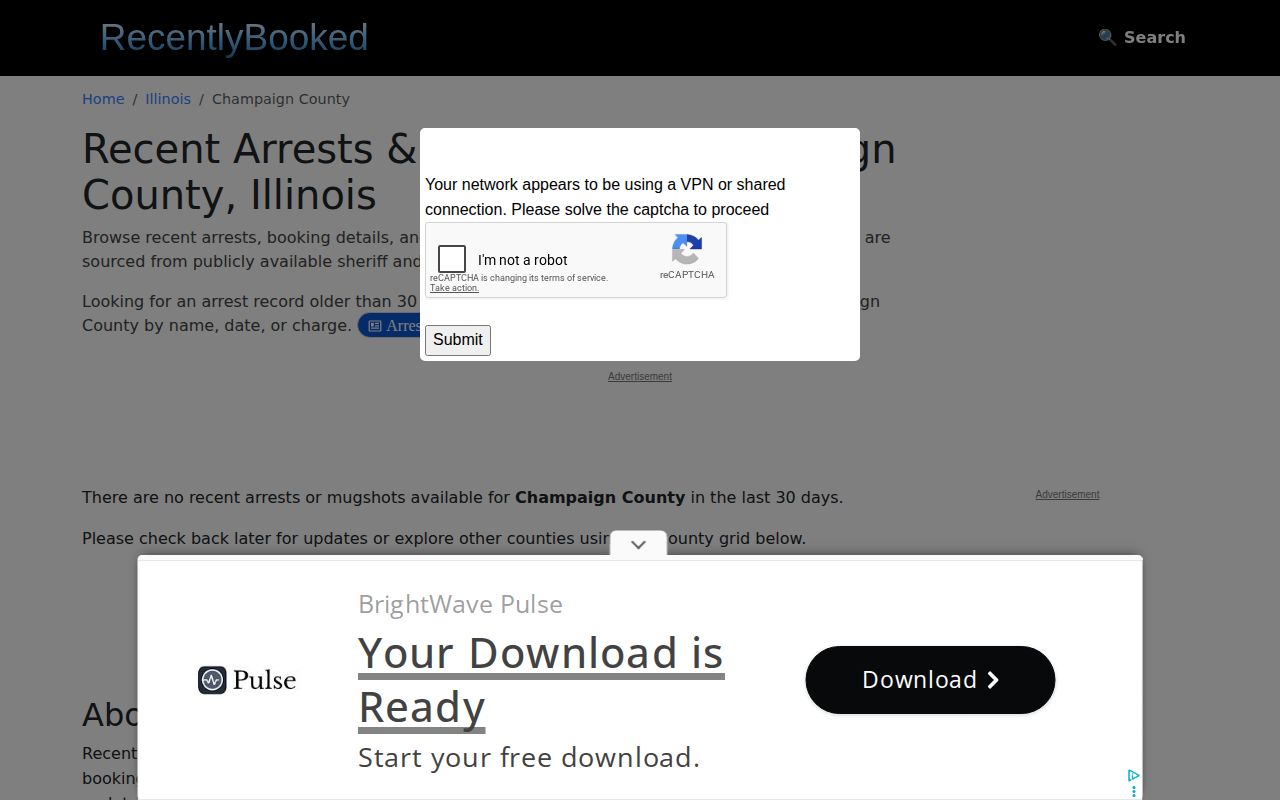
The interface appears for source comparison only. Confirm any name, date, and agency against the county or city record before relying on it.
Historical Indexes Are Not Current Custody
Mugshots.com's Champaign County section offers alphabetical navigation, city links, photos, and dates stretching back years. An archive like that can explain why a name pops up in a search result. It cannot tell you whether the person sits in the county jail today. It cannot say what a court later decided, either.
A screenshot of that local section documents the historical nature of the source. It is linked for comparison only, and no image is copied onto this page.
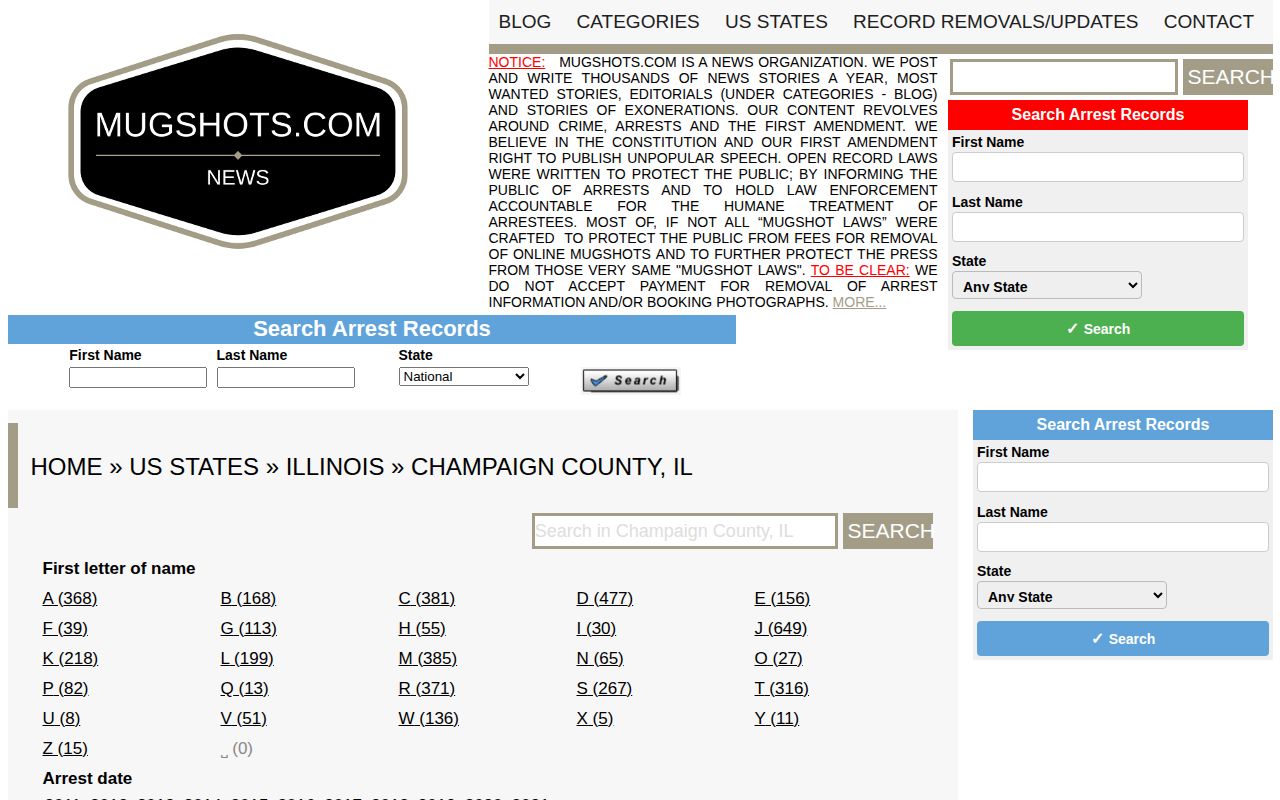
When you need a current answer, go back to the Sheriff portal, the dated booking report, the arresting agency, or the Circuit Clerk.
Follow the Champaign County Disposition
The best way to finish a crime story is with the public court result, when one exists. Booking details and article language can change. A court file may show dismissal, acquittal, supervision, amended charges, a plea, conviction, sentence, or another outcome.
The Circuit Clerk's public-access page spells out limits for juvenile, sealed, expunged, and other protected records. A case may simply not appear there. The honest read is that the public search is limited, not that absence proves anything.
Keep the systems straight. For an image or booking record, contact the Sheriff's records unit or the arresting police agency. For a court event, use the Clerk. For state-sentenced custody, use IDOC. Separating those channels makes any local news search sharper and more respectful of the people involved.